
If you have seen both NAD and NAD+ used in articles or product discussions, the difference can be confusing. The short answer is that NAD+ is one form of nicotinamide adenine dinucleotide, while NADH is its reduced counterpart.
In everyday language, people often use “NAD” as shorthand for the wider nicotinamide adenine dinucleotide system. In biochemistry, however, it is more accurate to distinguish between NAD+ and NADH because they have different roles in electron-transfer reactions.
NAD vs NAD+: The quick answer
| Term | What it means |
|---|---|
| NAD | A commonly used shorthand for the nicotinamide adenine dinucleotide coenzyme system or pool. The exact meaning depends on context. |
| NAD+ | The oxidised form of nicotinamide adenine dinucleotide. It can accept electrons during metabolic reactions. |
| NADH | The reduced form of nicotinamide adenine dinucleotide. It carries electrons that can later be transferred in cellular metabolism. |
So, NAD is not simply another name for NAD+. NAD+ and NADH are related forms that cycle between one another.
What does NAD+ do?
NAD+ is a coenzyme involved in normal cellular metabolism. During some metabolic reactions, NAD+ accepts a hydride equivalent, which contains two electrons, and becomes NADH.
This conversion can be represented simply as:
NAD+ + 2 electrons + H+ → NADH
NADH can then donate electrons in other reactions. In mitochondria, NADH can deliver electrons to complex I of the electron transport chain, where it is oxidised back to NAD+. This ongoing cycling helps support normal energy metabolism in cells.
NAD+ is therefore not “fuel” in the same way that carbohydrate or fat provides energy. It is better described as an essential coenzyme that helps cells transfer electrons during metabolic processes.
Is NAD the same as NAD+?
Not exactly.
“NAD” is often used as a broad label, but NAD+ specifically refers to the oxidised form. When an article, label or study says “NAD,” check the surrounding context to see whether it means the total NAD pool, NAD+, NADH, or another related molecule.
This distinction matters because NAD+ and NADH have opposite redox states:
- NAD+ is the oxidised form and can accept electrons.
- NADH is the reduced form and can donate electrons.
Together, they are known as a redox pair.
What is the NAD+/NADH ratio?
The NAD+/NADH ratio describes the relative amounts of the oxidised and reduced forms in a particular biological setting. Researchers use this ratio to study cellular redox conditions and metabolism.
However, the ratio is not a universal personal health score. It can differ between tissues, cell compartments and experimental conditions. A result in one laboratory setting should not be used on its own to diagnose health status or predict an outcome in an individual.
NAD+ vs NADH: which one is better?
Neither is simply “better.” NAD+ and NADH are designed to work together.
Cells need NAD+ to accept electrons during many reactions, and they need NADH to transfer those electrons onward. The important point is the normal cycling between the two forms, rather than trying to view one form as universally superior.
What does this mean for NAD-related supplements?
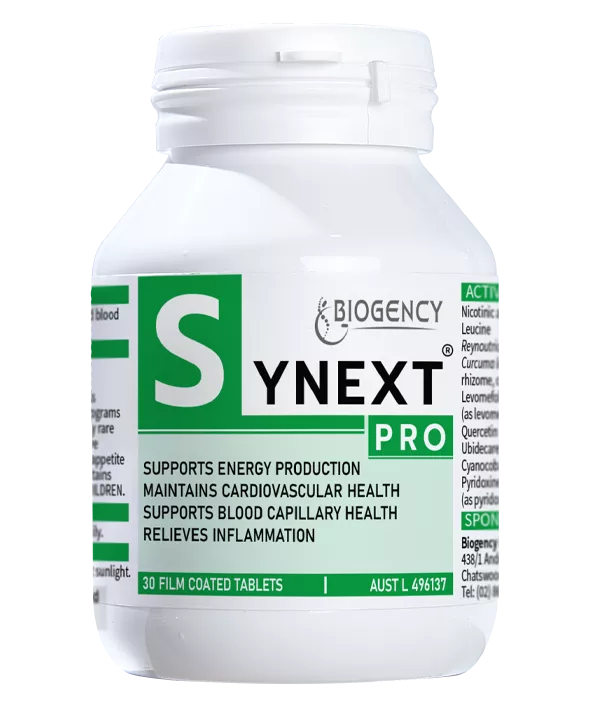
Understanding NAD+ biology is useful. That depends on the ingredient, formulation, dose, study population and quality of human evidence. Consumers should assess product information carefully and seek professional advice where appropriate, especially if pregnant, breastfeeding, managing a medical condition or using medication. Learn more about Biogency Synext.
Key takeaway
The difference between NAD and NAD+ is mainly about precision:
- NAD is often used as a broad shorthand.
- NAD+ is the oxidised form that accepts electrons.
- NADH is the reduced form that carries electrons.
- NAD+ and NADH continually cycle as part of normal cellular metabolism.
This article is for general educational purposes only and is not medical advice.
Is NAD the same as NAD+?
No. NAD is often used as a broad shorthand, while NAD+ specifically refers to the oxidised form. NADH is the reduced form.
What is the difference between NAD+ and NADH?
NAD+ can accept electrons during metabolic reactions, while NADH carries electrons and can donate them in later reactions.
Is NAD+ better than NADH?
Neither is universally better. NAD+ and NADH are a functional redox pair that cycle between oxidised and reduced states during normal cellular metabolism.
Does the NAD+/NADH ratio diagnose health?
No. The NAD+/NADH ratio can differ between tissues, cell compartments and experimental settings. It should not be treated as a personal diagnostic score.