By Dr Sun. Translation of the original Zhihu article, last edited on 15 September 2019. This translation preserves the original author’s arguments and historical research context.
Summary
Let me start with a summary, as this article is somewhat technical.
- The essence of NAD+ supplementation is supplying the nicotinamide moiety. At the same dose, the more of this moiety a precursor can provide, the more NAD+ it can potentially be converted into.
- Among the three popular NAD+ precursors niacin, NR and NMN, NMN has the largest molecular weight and therefore the lowest conversion to NAD+ at the same dose. This has already been demonstrated in animal experiments.
- NAD+ metabolism in the human body is extremely complex. Choosing the right precursor is only the first step. To make the best use of NAD+, NAMPT, the rate-limiting enzyme of the NAD+ salvage pathway, also needs to be activated. Therefore, alongside a single NAD+ supplement, sufficient supporting ingredients working through multiple pathways are needed for the best effect.
Main article
An increasing number of studies show that replenishing NAD+ can benefit the human body. As is widely known, absorption issues mean that NAD+ can only be replenished by taking its precursors. Products containing various NAD+ precursors have recently become very popular. Supplements based on niacin or nicotinamide, NR or NMN have left consumers facing a bewildering choice. NMN is the most extreme example. Its supposedly high synthesis costs have led many products to sell for thousands, or even tens of thousands, per box.
Today, I will examine niacin, nicotinamide, NR and NMN solely as NAD+ precursors. This article compares the strengths and weaknesses of the precursors, rather than those of particular products. In addition to choosing the right precursor, a satisfactory NAD+ supplement also needs to address subsequent NAD+ recycling within the body. I will discuss that in a future article.
First, what is the essence of replenishing NAD+? The diagram below shows the chemical structures of four NAD+ precursors. They all belong to the vitamin B3 family. Why? Because they all contain a nicotinamide moiety, the part circled in red.
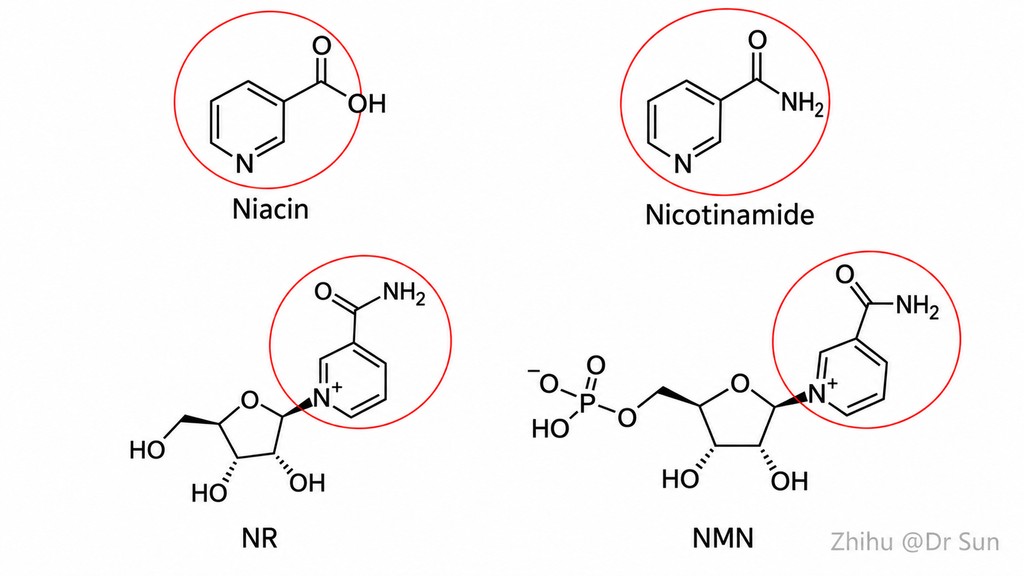
Members of the vitamin B3 family, all containing the nicotinamide moiety described in the original article.
Now let us look at the chemical structure of our final hero, NAD+.
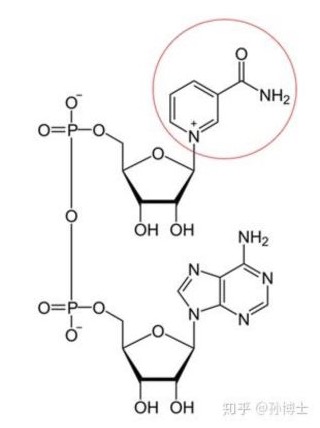
Like the other members of the B3 family, NAD+ also contains a nicotinamide moiety.
We can clearly see that the four NAD+ precursors and NAD+ itself share just one part, the nicotinamide moiety. Possessing this moiety is also one of the characteristics of the vitamin B3 family. Scientists’ naming conventions are interesting too. Nicotinamide riboside (NR), nicotinamide mononucleotide (NMN) and nicotinamide adenine dinucleotide (NAD+) all share the name nicotinamide, but their remaining parts are completely different. The essence of replenishing NAD+ therefore becomes clear. However the precursor changes, the part ultimately needed is the one shown below.
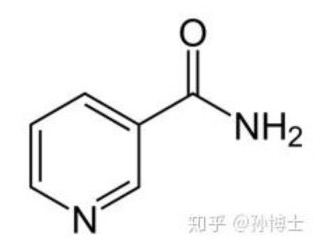
Nicotinamide moiety.
The simplest way to compare these precursors is therefore to compare the number of nicotinamide moieties they can supply at the same dose. The more they can supply, the more NAD+ the precursor can be converted into, and the better the precursor. Simple enough, right?
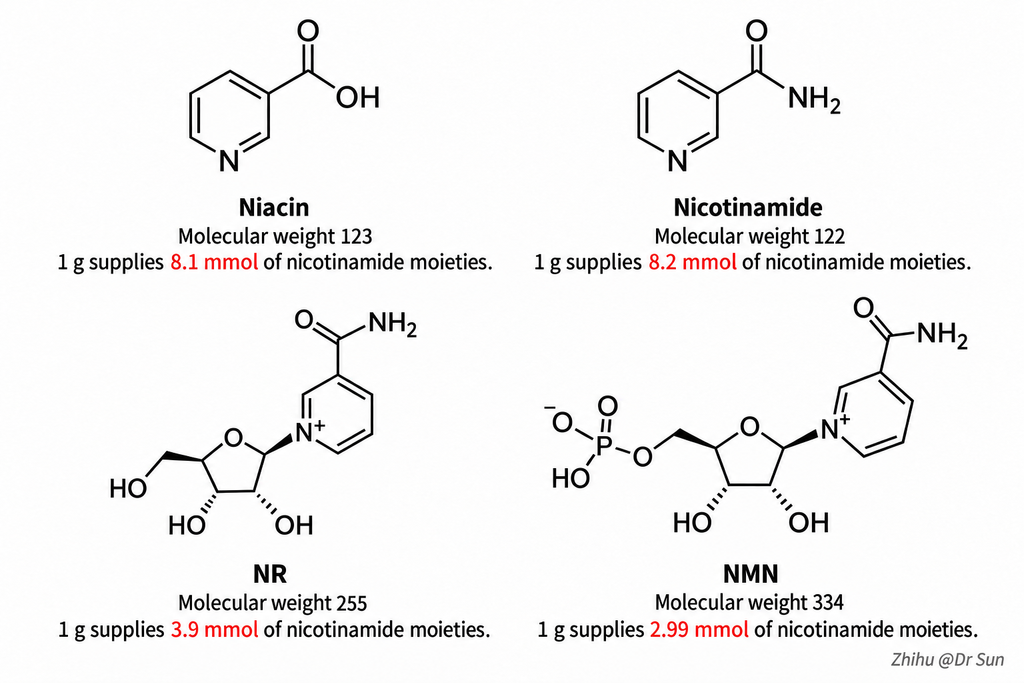
Millimoles of the nicotinamide moiety supplied by a 1 g dose of each of the four precursors.
Using a dose of 1 g as the basis for comparison, niacin, nicotinamide, NR and NMN can supply 8.1 mmol, 8.2 mmol, 3.9 mmol and 2.99 mmol of the nicotinamide moiety, respectively. From this perspective, nicotinamide comes first, narrowly ahead of niacin. The poorest performer is NMN, currently the most expensive. At the same dose, it supplies less than half as much of the nicotinamide moiety as niacin.
These calculations give us only a theoretical comparison of the four NAD+ precursors. Are there data comparing them directly in living organisms? The answer is yes. A study published in 2013 in a journal in the Cell family provides just such a comparison.
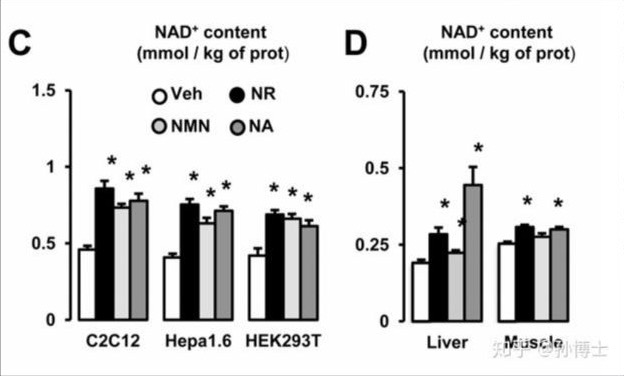
Panel C compares three precursors at equal molar amounts, rather than equal mass doses, in cell experiments. Panel D compares three precursors at equal mass doses in mice.
The image above reproduces panels C and D from Figure 1 of that study. Panel C compares conversion to NAD+ in cells using equal molar amounts of the precursors. Since in practice we do not use molar amounts and do not conduct experiments only in cells, I will set aside the results in panel C.
In panel D, mice were given the same dose, 400 mg/kg per day, of three NAD+ precursors, NR, NMN and NA (niacin). After seven days, liver NAD+ levels in the niacin group were much higher than those in the NR and NMN groups. In muscle, NAD+ was slightly higher in the NR group than in the niacin group, but levels in both groups were significantly higher than those in the NMN group.
The niacin group showed the best conversion to NAD+, while the NMN group showed the poorest. The experimental results therefore broadly agree with the theoretical calculations. The slightly higher NAD+ level in the NR group than in the niacin group is related to inhibition of relevant enzymes when NR breaks down into nicotinamide. It does not mean that NR has a positive effect on NAD+ metabolism. I may analyse this in a future article.
As the only ingredient currently supported by large-scale clinical evidence of efficacy, as well as indirect evidence of extending human lifespan, niacin is currently the most effective and safest NAD+ precursor. I do not doubt that NMN works. However, to achieve the same precursor effect as niacin, NMN would require at least 2.7 times the dose of niacin. In my view, a precursor like this, especially as a single ingredient, is simply not worth such a high price.
Why, then, is nicotinamide not often used as an NAD+ precursor in experiments or supplements, even though niacin and nicotinamide supply almost the same number of nicotinamide moieties at equal doses? This brings us to the complexity of NAD+ metabolism.
In addition to external sources, an important proportion of the NAD+ used by the body comes from recycling nicotinamide back into NAD+ through the salvage pathway. NAMPT, the most important enzyme in this pathway and the enzyme controlling NAD+ recycling, converts nicotinamide into NMN and is easily saturated.
Nicotinamide is like firewood, while NAMPT is only a small stove. You can pile up a great deal of firewood, but the small stove cannot burn it all at once, so the final effect will be limited. Exercise, calorie restriction and certain plant-derived ingredients can turn the small stove into a larger one. However, NAD+ recycling is not the focus of this article. I will discuss it properly when the opportunity arises.
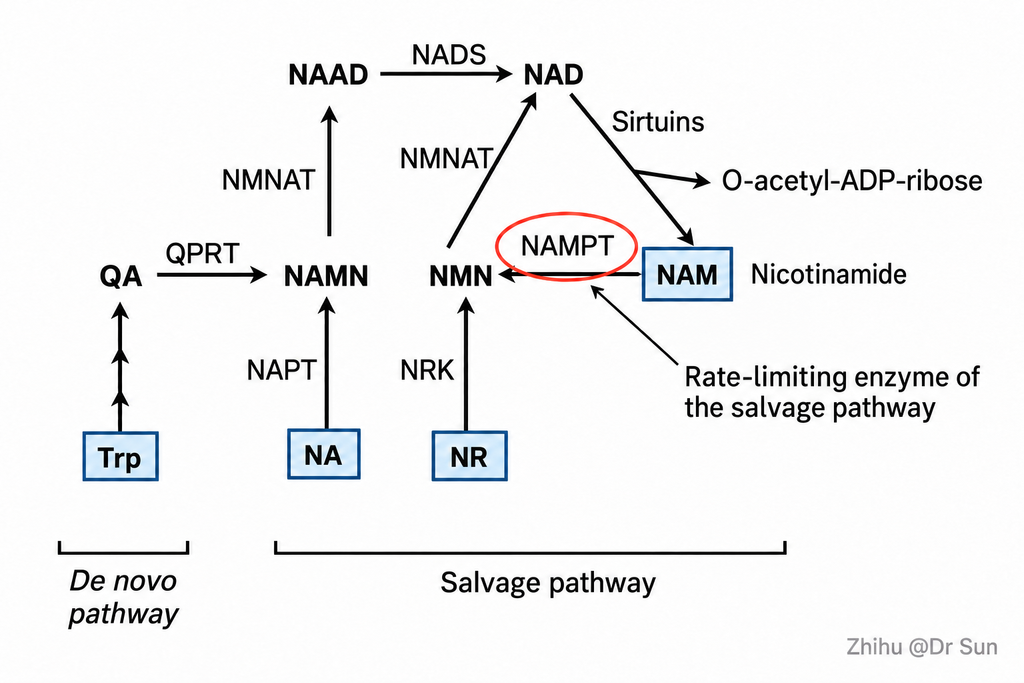
NAD+ salvage pathway and NAMPT.
To summarise, the human body is an extremely complex system, and a single-ingredient NAD+ supplement is only a starting point. A satisfactory NAD+ supplement must first contain the right precursor. It must then contain sufficient ingredients to enhance NAD+ recycling, along with enough supporting ingredients to supply the coenzymes and other elements required by the NAD+ metabolic pathways. Only when these conditions are met can the additional NAD+ in the body participate freely in metabolism and provide benefits.
Reference
Cantó et al. (2013). The NAD+ precursor nicotinamide riboside enhances oxidative metabolism and protects against high-fat diet induced obesity. Cell Metab. 2012 Jun 6;15(6):838–847. doi: 10.1016/j.cmet.2012.04.022.