
By Dr Sun. English translation of the original Zhihu article, last edited on 7 September 2020. This translation preserves the author’s explanations, interpretations and recommendations in their original research context. It is not an updated review of the evidence.
In previous articles, I have repeatedly emphasised that maintaining efficient NAD+ recycling is more important than taking NAD+ precursors alone. By NAD+ recycling, I have mainly meant the process in which nicotinamide, a product of NAD+ metabolism, is converted by NAMPT into NMN and ultimately back into NAD+, allowing it to be used again by the relevant enzymes.
The most important rate-limiting enzyme in this process, NAMPT, can be increased through activation of the AMPK pathway. This is why I have suggested combining NAD+ precursors with changes in lifestyle or the use of AMPK activators to support this recycling process and maintain NAD+ levels and associated metabolism. Today, I would like to discuss another important form of NAD+ recycling: the interconversion of NADH and NAD+.
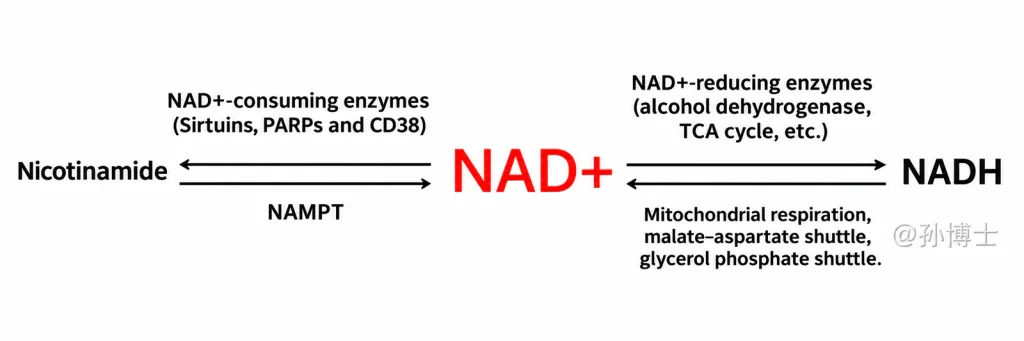
Two categories of NAD+ reactions: use as a cosubstrate, producing nicotinamide, and redox reactions, producing NADH.
The two main roles of NAD+
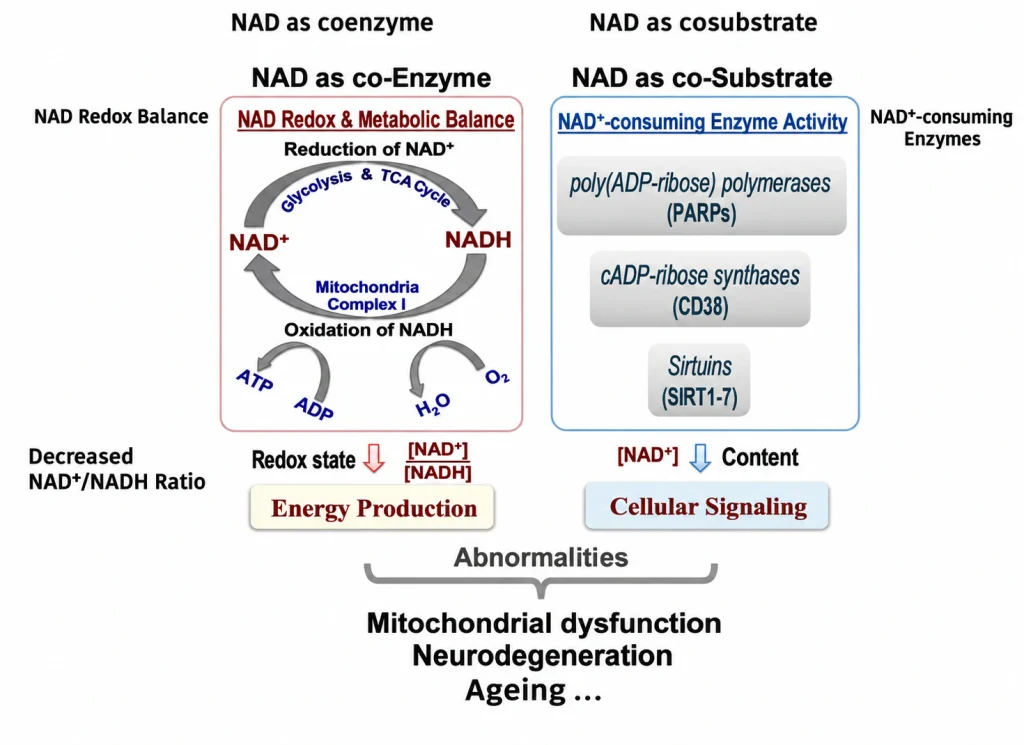
NAD+ is essential for cellular survival, and its reactions can broadly be divided into two categories. The first is its role as a cosubstrate, providing fuel for enzymes such as sirtuins, commonly discussed in ageing research, and PARPs, which participate in DNA repair. These are also called NAD+-consuming enzymes because their activity converts NAD+ into nicotinamide. In the anti-ageing theories discussed here, the purpose of increasing NAD+ is to sustain the activity of these enzymes.
The second role of NAD+ is as a coenzyme that helps maintain redox balance. In these reactions, NAD+ supports enzymes that reduce it to NADH. Important examples include enzymes involved in energy production, such as glyceraldehyde-3-phosphate dehydrogenase in glycolysis and isocitrate dehydrogenase in the tricarboxylic acid cycle.
Other well-known examples are alcohol dehydrogenase and aldehyde dehydrogenase, two enzymes required for alcohol metabolism. The original article suggests that their dependence on NAD+ may help explain why some people report increased alcohol tolerance after taking NAD+ precursors. What these enzymes have in common is that they convert NAD+ into NADH, its reduced form.
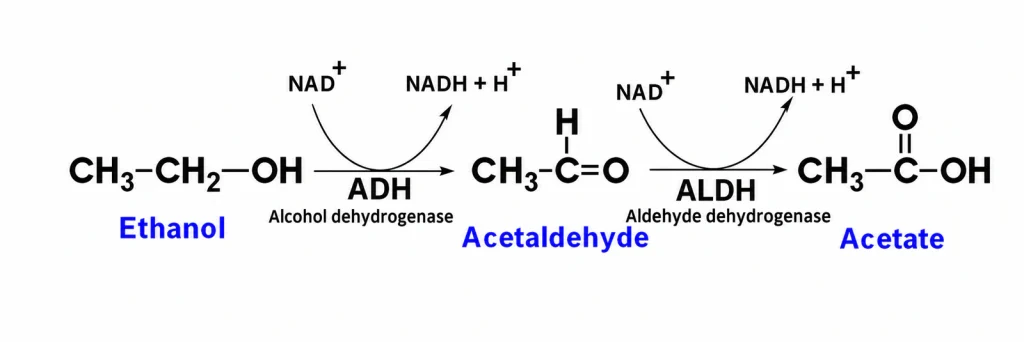
Metabolism of one ethanol molecule involves conversion of two NAD+ molecules into two NADH molecules.
NADH: a product of NAD+ metabolism with parallels to nicotinamide
NADH does not perform the same roles as NAD+. In several respects, I see parallels between NADH and nicotinamide, another product of NAD+ metabolism. These can be described in three ways.
First, both NADH and nicotinamide are formed after NAD+ participates in enzyme reactions, and both can be converted back into NAD+ through different processes.
Second, the original article describes NADH levels, like nicotinamide levels, as increasing with age. Studies of the human brain and plasma have reported lower NAD+ levels and higher NADH levels with increasing age, resulting in a lower NAD+/NADH ratio. Many studies therefore examine this ratio rather than NAD+ concentration alone. Increasing the ratio, either by raising NAD+ or lowering NADH, has produced beneficial responses in various cell and animal experiments.
Third, the original article describes NADH, like nicotinamide, as an inhibitor of sirtuins. In this interpretation, insufficient or impaired conversion of NADH back into NAD+ can allow NADH to accumulate and inhibit sirtuins, with potentially negative effects.
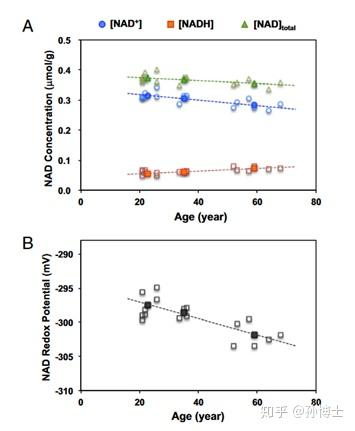
Panel A shows age-related changes in NAD+, NADH and total NAD in the human brain. NAD+ and total NAD decrease with age, while NADH increases. The original article describes Panel B as illustrating the decline in the NAD+/NADH ratio; the plotted vertical axis is NAD redox potential. Zhu et al., 2015.
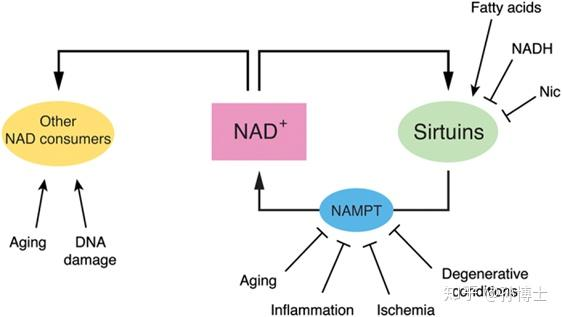
NADH is shown as an inhibitor of sirtuins. Imai and Guarente, 2016.
Three processes involved in NADH recycling
Within cells, NADH is generally reoxidised to NAD+ through three processes discussed here: the mitochondrial respiratory chain, also called the electron transport chain, the malate–aspartate shuttle, and the glycerol phosphate shuttle. The respiratory chain operates in the inner mitochondrial membrane. The original article discusses the two shuttles in relation to the cytosol and the space between the inner and outer mitochondrial membranes. Each process has important functions and depends on different enzymes and cofactors.
The mitochondrial respiratory chain
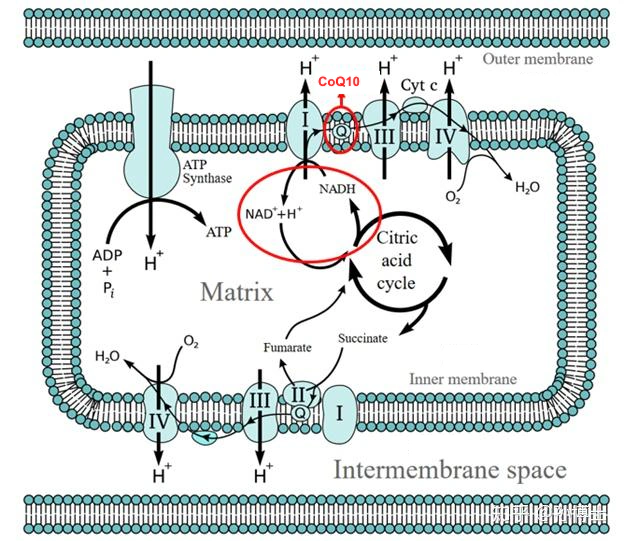
The mitochondrial respiratory chain operates in the inner mitochondrial membrane.
The respiratory chain is located in mitochondria and is a major part of the process by which the body obtains energy from food. Starting with glucose and ending with ATP production, the process can be divided into three stages.
The first is glycolysis, which takes place in the cytosol and converts NAD+ into NADH. For each glucose molecule, two NAD+ molecules are converted into two NADH molecules.
Glucose is broken down into pyruvate, which enters the mitochondria. The original article groups the subsequent processing of pyruvate with the second stage, the tricarboxylic acid cycle, describing a total of eight NAD+ molecules converted into eight NADH molecules for the pyruvate derived from one glucose molecule.
The third stage is the mitochondrial respiratory chain, associated with the largest share of ATP production. In the author’s explanation, NADH formed during the preceding reactions is reoxidised to NAD+ through the respiratory chain, in which coenzyme Q10 plays an important role, while large amounts of ATP are produced.

NADH recycling, route 1. A respiratory-chain reaction linking NADH oxidation to the reduction of coenzyme Q.
In simple terms, the first two stages of obtaining energy from glucose convert NAD+ into NADH. The final respiratory-chain stage reoxidises NADH into NAD+, allowing it to be used again. The original article highlights coenzyme Q10 as a key participant in this process and describes a 1:1 relationship between NADH oxidation and coenzyme Q reduction.
The malate–aspartate and glycerol phosphate shuttles
One point needs to be emphasised: NADH molecules themselves cannot cross the inner mitochondrial membrane. On this basis, I question claims that taking NADH from an external source necessarily increases energy production. My argument in the original article is that NADH generated inside mitochondria can participate directly in the respiratory chain, whereas externally supplied NADH cannot simply cross the inner membrane and enter that chain.
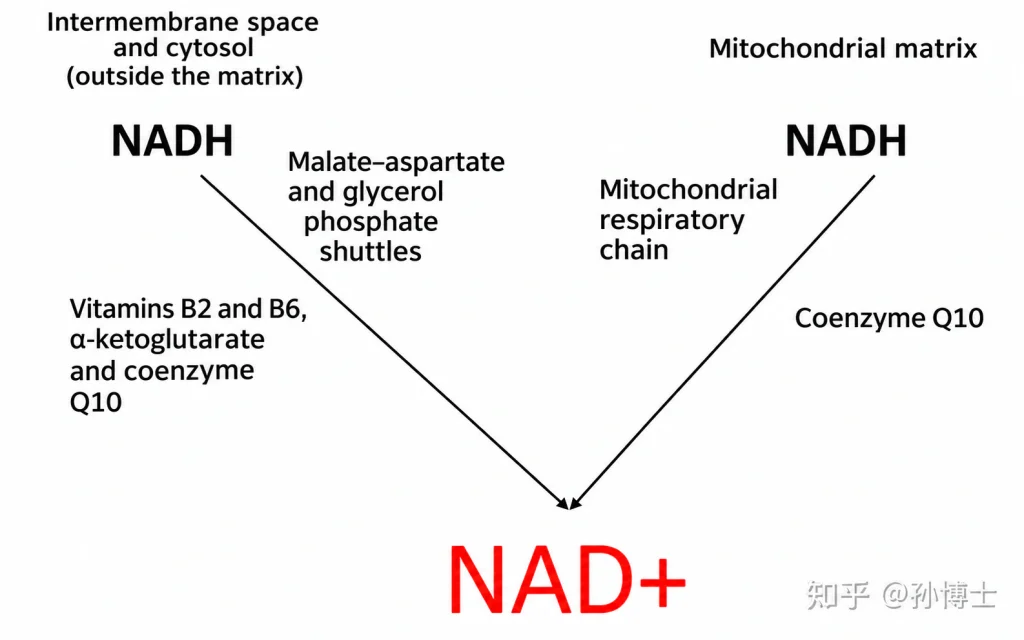
NADH generated outside the mitochondrial matrix, including that produced during glycolysis, is reoxidised by enzymes and cofactors associated with two shuttle systems. This regenerates NAD+ for further reactions.
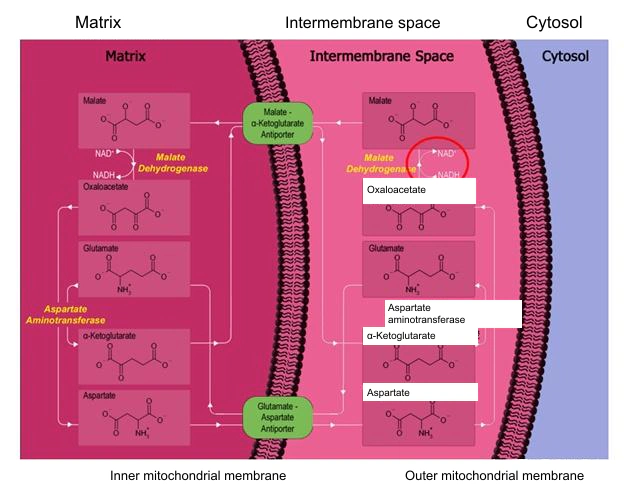
NADH recycling, route 2: the malate–aspartate shuttle.
In the original article’s explanation, the malate–aspartate shuttle uses oxaloacetate to oxidise NADH outside the mitochondrial matrix. Oxaloacetate is regenerated through a reaction catalysed by aspartate aminotransferase. Two important supporting substances are α-ketoglutarate and pyridoxal phosphate.
Pyridoxal phosphate may sound unfamiliar, but it is the active form of vitamin B6. In other words, the author argues that adequate α-ketoglutarate and vitamin B6 are needed to support conversion of NADH outside the mitochondria back into NAD+ through the malate–aspartate shuttle.
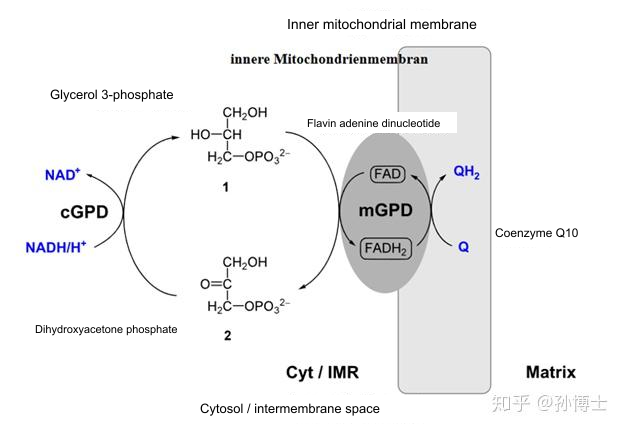
NADH recycling, route 3: the glycerol phosphate shuttle.
The glycerol phosphate shuttle serves a similar purpose, reoxidising NADH associated with the cytosol to regenerate NAD+. In this system, the molecule accepting reducing equivalents from NADH is dihydroxyacetone phosphate. Dihydroxyacetone phosphate is regenerated when glycerol 3-phosphate is oxidised in a reaction involving flavin adenine dinucleotide, or FAD.
FAD is therefore one of the important cofactors in this shuttle. The body makes it using vitamin B2 as a precursor. The author accordingly emphasises the need for sufficient vitamin B2 to support the process.
Coenzyme Q10 also plays an important role in the glycerol phosphate shuttle. In the inner mitochondrial membrane, it receives electrons associated with the reduced flavin cofactor, allowing the process to continue.
To summarise the author’s explanation, coenzyme Q10 participates in the respiratory-chain processes that reoxidise NADH generated within the mitochondrial matrix. For NADH generated outside the matrix, the article highlights α-ketoglutarate, vitamins B2 and B6, and coenzyme Q10 as supporting substances for the two shuttle systems.
Conclusion
In summary, I regard NADH as another product of NAD+ metabolism, with parallels to nicotinamide. The original article argues that the NAD+/NADH ratio tends to decline during ageing and that this may be associated with reduced activity of NAD+-consuming enzymes.
The proposed approach discussed here is to support another form of NAD+ recycling by promoting conversion of NADH back into NAD+ through the mitochondrial respiratory chain, the malate–aspartate shuttle and the glycerol phosphate shuttle. NAD+ regenerated through these processes is formed within cells and mitochondria.
Several of the substances highlighted in these processes, α-ketoglutarate, vitamins B2 and B6, and coenzyme Q10, can be obtained through external intake. The author’s proposal in 2020 was that adding them alongside NAD+ precursors and AMPK activators might further increase NAD+ levels by supporting NADH recycling. This is the original article’s hypothesis and recommendation.
Finally, I reiterate the original article’s argument that externally supplied NADH cannot itself cross the inner mitochondrial membrane and therefore cannot directly participate in the respiratory chain to generate energy. The article also speculates that orally consumed NADH might not pass through the digestive tract intact.
References
- Stryer L, Berg JM, Tymoczko JL. Biochemistry. San Francisco: W. H. Freeman; 2007. ISBN 0-7167-8724-5. Original reference notes an archived version dated 18 May 2007.
- Krieger M, Scott MP, Matsudaira PT, Lodish H, Darnell JE, Zipursky L, Kaiser C, Berk A. Molecular Cell Biology. Fifth edition. San Francisco: W. H. Freeman. ISBN 0-7167-4366-3.
- Søballe B, Poole RK. Microbial ubiquinones: multiple roles in respiration, gene regulation and oxidative stress management. Microbiology. 1999;145(8):1817–1830.
- Crane FL. Biochemical functions of coenzyme Q10. J Am Coll Nutr. 2001 Dec 1;20(6):591–598. DOI: 10.1080/07315724.2001.10719063. PMID 11771674.
- Srivastava S. Emerging therapeutic roles for NAD+ metabolism in mitochondrial and age-related disorders. Clinical and Translational Medicine. 2016;5:25.
- Zhu XH et al. In vivo NAD assay reveals the intracellular NAD contents and redox state in healthy human brain and their age dependences. Proc Natl Acad Sci U S A. 2015 Mar 3;112(9):2876–2881. DOI: 10.1073/pnas.1417921112.
- Titov DV et al. Complementation of mitochondrial electron transport chain by manipulation of the NAD+/NADH ratio. Science. 2016 Apr 8;352(6282):231–235. DOI: 10.1126/science.aad4017.
- Clement J et al. The Plasma NAD+ Metabolome Is Dysregulated in “Normal” Aging. Rejuvenation Res. 2019 Apr 1;22(2):121–130.
- Imai S, Guarente L. It takes two to tango: NAD+ and sirtuins in aging/longevity control. NPJ Aging Mech Dis. 2016;2:16017.
- Lin et al. Calorie restriction extends yeast life span by lowering the level of NADH. Genes Dev. 2004 Jan 1;18(1):12–16.
- Lee JS et al. Beta-lapachone, a modulator of NAD metabolism, prevents health declines in aged mice. PLoS One. 2012;7(10):e47122. DOI: 10.1371/journal.pone.0047122.
- Xin et al. Nutritional Ketosis Increases NAD+/NADH Ratio in Healthy Human Brain: An in Vivo Study by 31P-MRS. Front Nutr. 2018 Jul 12. DOI: 10.3389/fnut.2018.00062.