By Dr Sun, a translation of the original article on Zhihu.
Summary
This article covers quite a few points, so I will begin with a summary.
- Among NAD+ precursors, nicotinamide is the poorest option. There is not yet enough evidence for NR, otherwise it could largely be placed in the same category as nicotinamide. Apart from this, no particular precursor is metabolically superior to the others. Taking a single NAD+ precursor can increase NAD+ levels on one occasion, but cannot increase the rate at which NAD+ is reused.
- Externally supplied NAD+ precursors account for only a small proportion of the total NAD+ the body uses each day. The enzyme NAMPT is a more important factor in maintaining NAD+ levels. The four precursors other than nicotinamide can bypass NAMPT when they first form NAD+. After use, however, all of them become nicotinamide and must pass through NAMPT in the salvage pathway to be recycled into NAD+. Otherwise, nicotinamide may accumulate and cause toxicity, or be permanently excreted through a process that consumes methyl groups, potentially causing various adverse effects.
- Recent research shows that enhancing NAMPT alone, even without additional NAD+ precursors, can have anti-ageing and lifespan-extending effects in mice. This further illustrates the importance of NAD+ recycling.
- When choosing NAD+ supplements, favour multi-ingredient formulations, which generally include ingredients intended to enhance NAMPT, and choose single-ingredient supplements less often. A healthy lifestyle also matters. Maintain an exercise habit, avoid eating too frequently or overeating, and make the most of the benefits of increased NAD+.
Main article
In my previous article comparing niacin, nicotinamide, NR and NMN by molecular weight, I introduced the concept of NAD+ recycling. Today, let us take a closer look at what happens to NAD+ precursors after they are swallowed.
There are two categories of NAD+ sources in the human body. One is externally supplied NAD+ precursors, generally obtained from the diet. The main sources are tryptophan in protein and dietary vitamin B3, including niacin and nicotinamide. A few days ago, I saw an article claiming that NMN in food is the main source of NAD+. I could hardly believe it. Perhaps I will discuss pellagra next time. Other NAD+ precursors, such as NR and NMN, can also be taken as supplements.
As discussed in the previous article, the essence of all externally supplied NAD+ precursors is to provide nicotinamide moieties that participate in NAD+ metabolism. However, these additional moieties account for only a small proportion of the NAD+ the body needs to use each day, and they provide only a one-off increase when we eat or take supplements. The body needs NAD+ constantly to support energy provision and the work of its enzymes. Where does that NAD+ come from?
This brings us to the process that maintains NAD+ levels over time, NAD+ recycling through the salvage pathway. In a sentence, an enzyme called NAMPT rescues NAD+ that has been “used up” and turned into nicotinamide. It allows the nicotinamide to form NAD+ again and continue participating in the relevant reactions, so the supplied nicotinamide moieties can be recycled repeatedly.
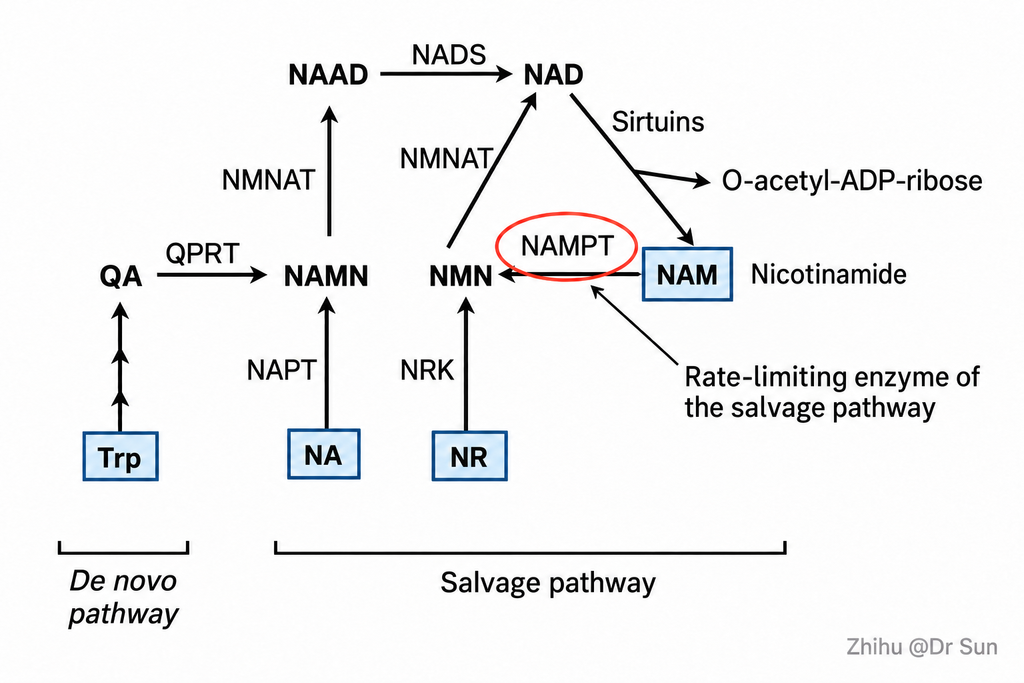
NAD+ metabolic pathways. Trp denotes tryptophan, NA denotes niacin, and NAM denotes nicotinamide.
However, our rescuer NAMPT has limited strength. It is a rate-limiting enzyme in the salvage pathway. What does this mean? Under normal conditions, the enzyme works at full capacity over long periods. No matter how much nicotinamide accumulates inside the cell, the amount it can rescue per second is fixed.
This creates a bottleneck. Supplementing NAD+ precursors alone brings more nicotinamide moieties into NAD+ metabolism, but they get held up at NAMPT. A precursor alone can therefore increase NAD+ levels in the short term. Once the first batch of newly formed NAD+ has been consumed, however, unchanged NAMPT activity limits subsequent recycling, making it impossible to maintain NAD+ levels for long.
Besides explaining NAD+ recycling, I also want this article to challenge certain unscrupulous sellers who claim that NR and NMN are superior to other precursors because they can bypass NAMPT when participating in NAD+ reactions. Such willingness to say anything for profit is disgraceful. I will therefore explain the metabolic routes of five NAD+ precursors after ingestion.
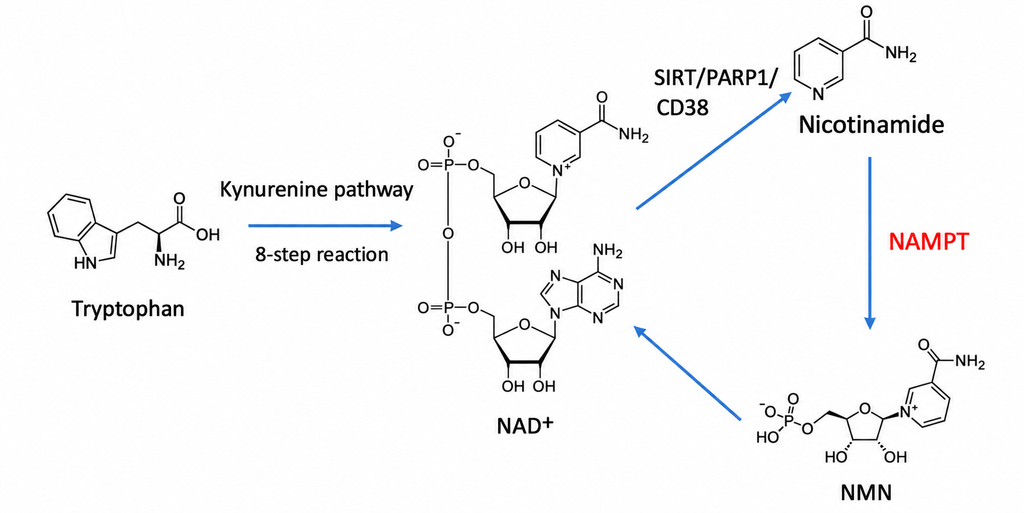
Tryptophan pathway.
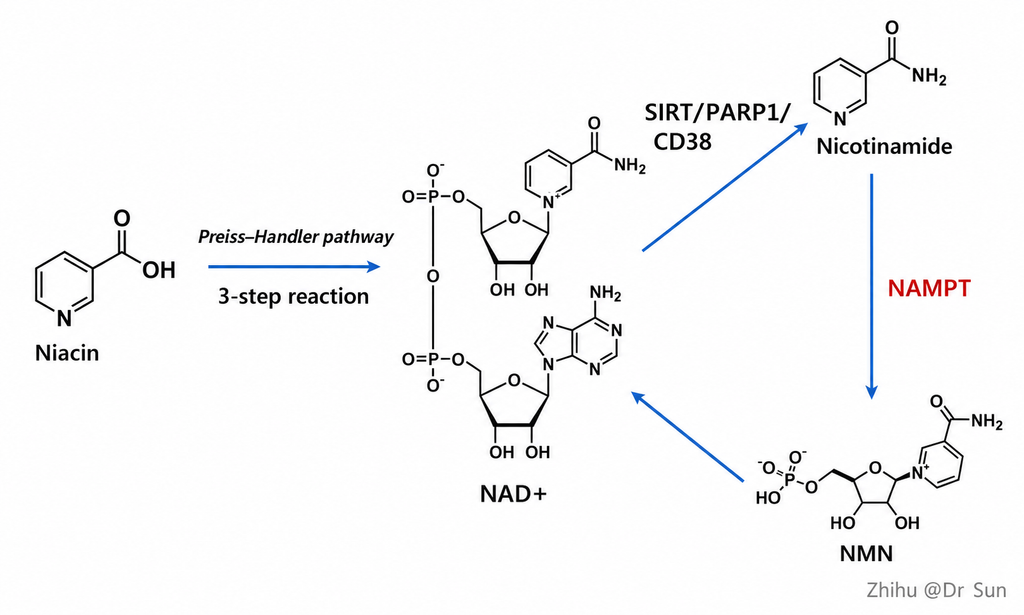
Niacin pathway.
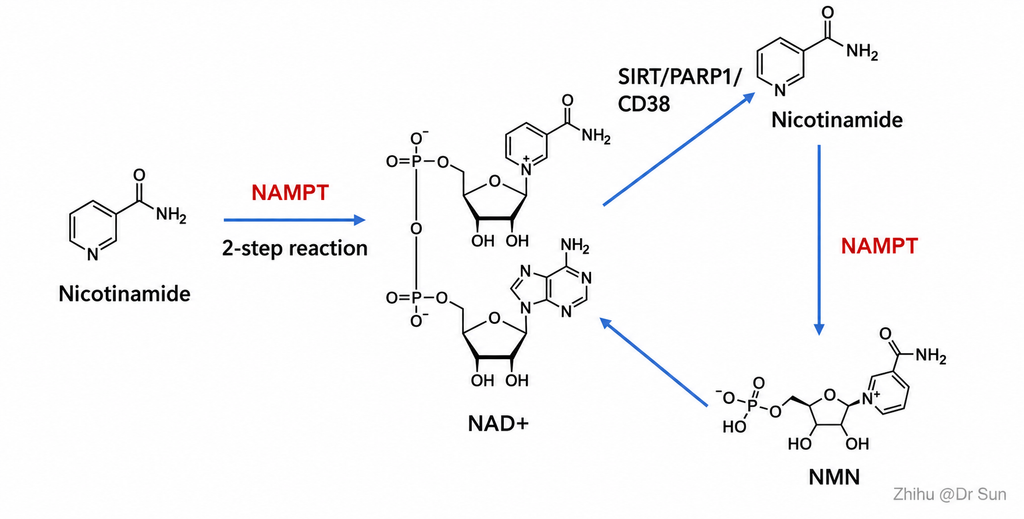
Nicotinamide pathway.
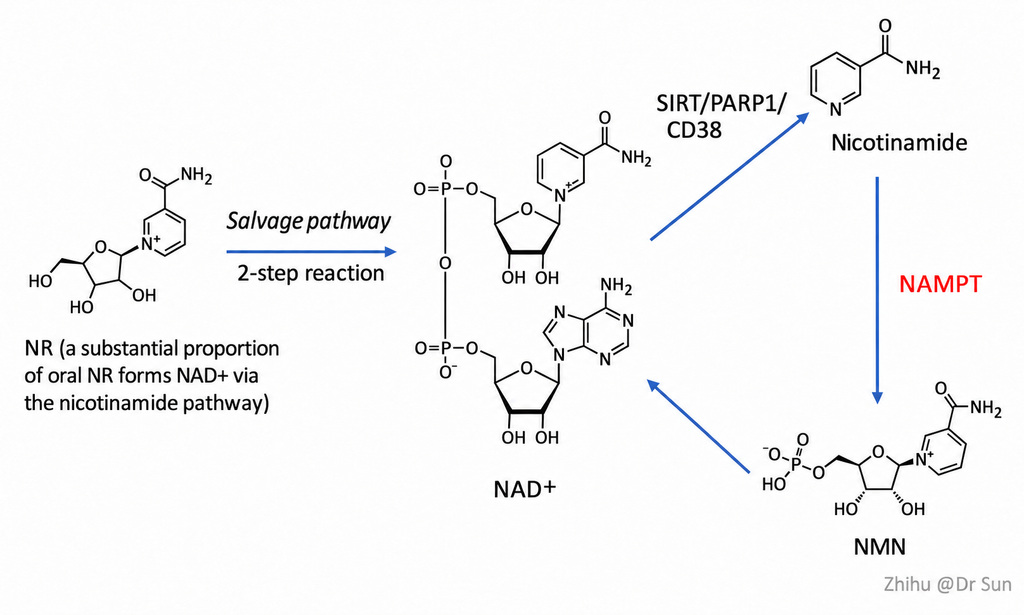
NR pathway.
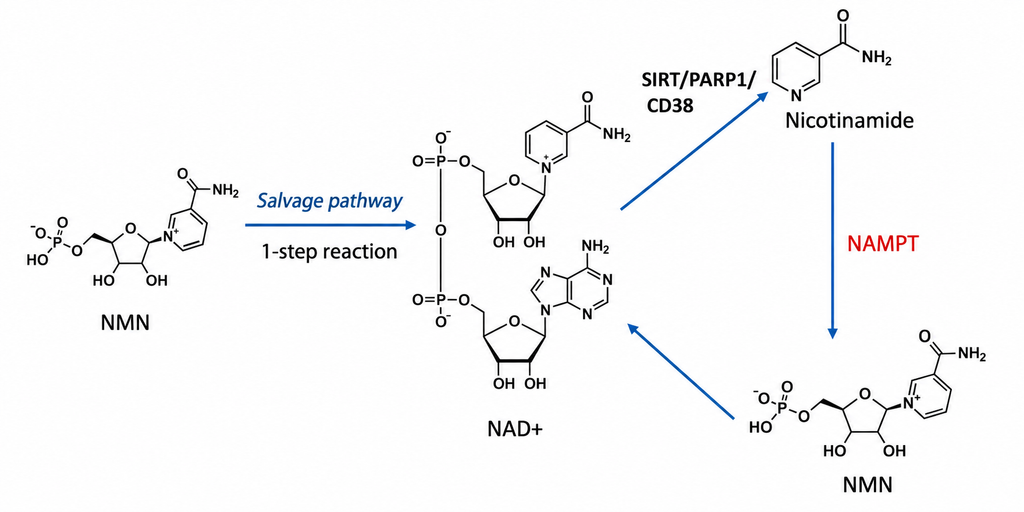
NMN pathway.
The diagrams can be summarised as follows. All NAD+ precursors other than nicotinamide, namely niacin, tryptophan, NR and NMN, can bypass NAMPT when they first form NAD+. After that initial synthesis, none can bypass the rate-limiting enzyme NAMPT.
Now that the principle of NAD+ recycling is clearer, let us look at the relationship between nicotinamide accumulation and NAMPT. Many studies show that nicotinamide accumulation can cause toxicity. Where does this toxicity come from? Nicotinamide itself inhibits the NAD+-consuming enzymes SIRT and PARP1.
NAD+ promotes health and counters ageing by activating the longevity-associated SIRT enzymes and the DNA repair enzyme PARP1. If SIRT and PARP1 are two guns, NAD+ is the ammunition, while nicotinamide is the spent cartridge case left after a shot is fired. Those spent cases can jam the guns.
Under everyday conditions, tryptophan and niacin in food can maintain normal SIRT and PARP1 activity. After taking a single NAD+ precursor, NAD+ levels can rise briefly and increase SIRT and PARP1 activity. However, because NAMPT remains unchanged, more nicotinamide is produced. Once the accumulated nicotinamide reaches a sufficiently high concentration, its inhibitory effect reduces SIRT and PARP1 activity.
Although this can itself raise NAD+ levels, that NAD+ is not merely unhelpful to the body, but harmful. In reviewing an NR study, a reviewer for Nature Communications noted that the substantial increase in nicotinamide after NR supplementation might inhibit, rather than stimulate, NAD+-consuming enzymes.
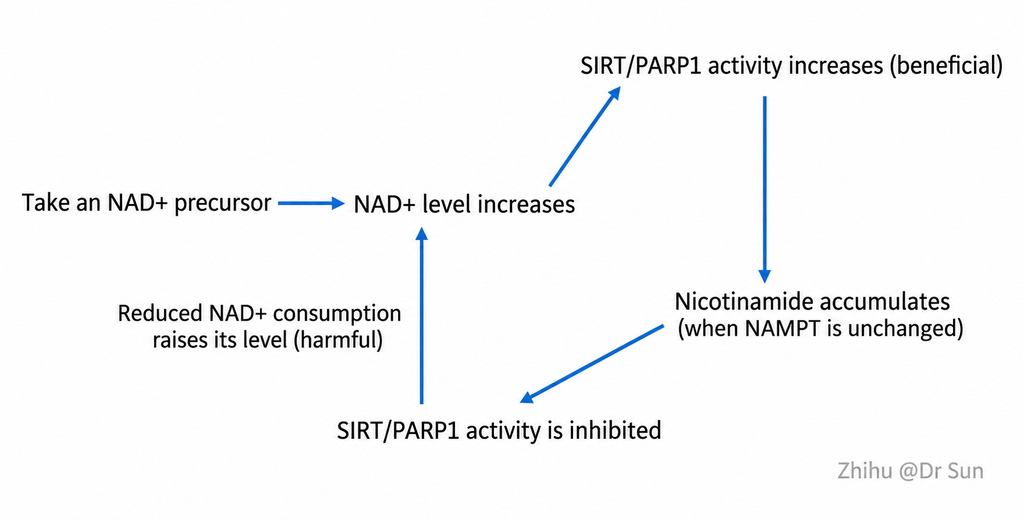
Nicotinamide accumulation and inhibition of SIRT/PARP1.
Fortunately, converting nicotinamide through NAMPT is not the body’s only way to deal with its accumulation. Nicotinamide can also be methylated and excreted in urine. This route has two drawbacks. First, it consumes a large number of methyl groups, which may affect the body’s carbon cycle. Second, the additional nicotinamide moieties supplied are permanently lost. Even so, this pathway is preferable to allowing nicotinamide to accumulate and cause toxicity.
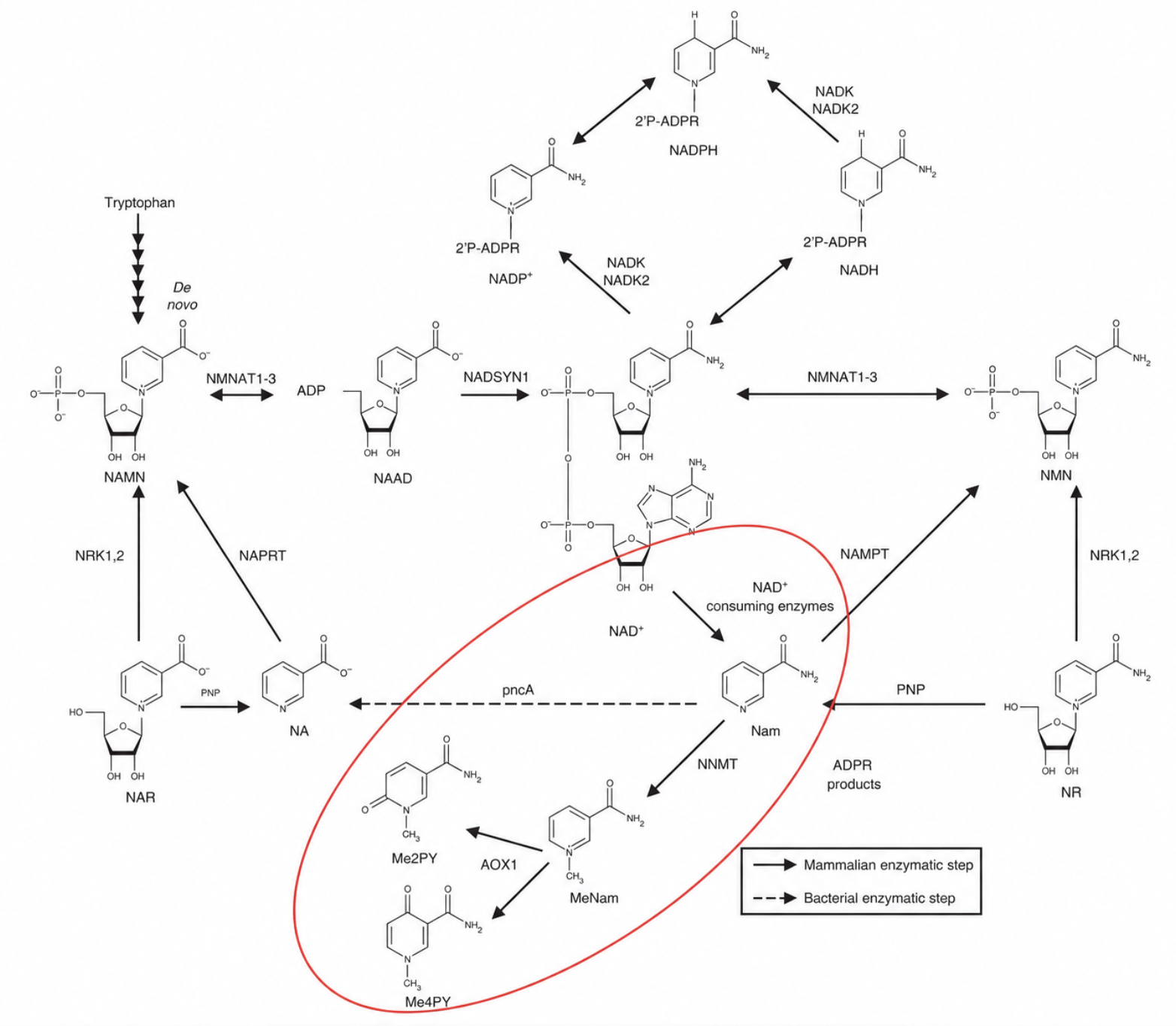
Nicotinamide methylation and excretion, a pathway that consumes methyl groups.
Based on these points, supplementing NAD+ precursors is only the first step in an anti-ageing approach. The aim of supplementation is to maintain NAD+ levels over time while minimising the accumulation of potentially toxic nicotinamide, and to recycle as much nicotinamide as possible into NAD+ through the salvage pathway rather than losing it through methylation and excretion. Everything therefore comes back to enhancing NAMPT.
Indeed, a mouse study in May of this year showed that injections of externally supplied NAMPT alone could have anti-ageing and lifespan-extending effects. Researchers have also begun investigating small molecules that activate NAMPT. However, injecting external proteins and developing new molecules carry considerable risks and take a long time. What can we do now?
Intermittent fasting, calorie restriction and exercise, the three enduring principles of anti-ageing, are the first choices. They can indirectly enhance NAMPT through the AMPK pathway and thereby improve NAD+ recycling. I may write about AMPK in a future article. This is one of the better-supported hypotheses explaining how these three lifestyle approaches could counter ageing and extend lifespan.
If lifestyle habits really cannot be changed, other substances may help. For example, rapamycin and metformin can inhibit mTOR, activate the AMPK pathway and enhance NAMPT. For the general public, however, the adverse effects of these drugs may outweigh their benefits. When choosing an NAD+ supplement, therefore, favour a multi-ingredient formulation rather than a single NAD+ precursor.
References
- Pitche. (2005). Pellagra. Sante. 15(3):205–08. PMID 16207585.
- Trammell et al. (2016). Nicotinamide riboside is uniquely and orally bioavailable in mice and humans. Nature Communications. 7:12948.
- Yoshida et al. (2019). Extracellular Vesicle-Contained eNAMPT Delays Aging and Extends Lifespan in Mice. Cell Metab. 2019 Aug 6;30(2):329–342.e5. doi:10.1016/j.cmet.2019.05.015. Epub 2019 Jun 13.
- Hoshino et al. (1984). Nicotinamide methylation and its relation to NAD synthesis in rat liver tissue culture. Biochemical basis for the physiological activities of 1-methylnicotinamide. Biochim Biophys Acta. 1984 Sep 28;801(2):250–8.
- Gardell et al. (2019). Boosting NAD+ with a small molecule that activates NAMPT. Nature Communications. 10:3241.
- Brandauer et al. (2013). AMP-activated protein kinase regulates nicotinamide phosphoribosyl transferase expression in skeletal muscle. J Physiol. 2013 Oct 15;591(20):5207–20. doi:10.1113/jphysiol.2013.259515. Epub 2013 Aug 5.
- Cantó and Auwerx. (2012). Targeting SIRT1 to improve metabolism: all you need is NAD+? Pharmacol Rev. 2012 Jan;64(1):166–187.