
By Dr Sun. English translation of the original article on Zhihu, last edited on 12 May 2020. The discussion below reflects the original author’s views and the research context at the time.
In recent years, studies of NAD+ and anti-ageing have appeared one after another. Oral NAD+ precursor supplements have already produced many surprising results in animal experiments. Human clinical trials of NAD+ precursor supplements are also gradually getting underway, and the preliminary results have been relatively positive.
Scientific research involves presenting an experimental design, the results, and the researchers’ own analysis and conclusions for others to examine. It is not uncommon in science for a conclusion to be inconsistent with the objective experimental results. If that conclusion is then misinterpreted and amplified by media commentators without the relevant expertise, the consequences could be disastrous.
A recent paper published in Nature Cell Biology, a journal in the Nature family, was titled NAD+ metabolism governs the proinflammatory senescence-associated secretome. The title itself is quite clear. NAD+ metabolism can regulate the secretion of pro-inflammatory substances associated with senescent cells.
First, some background. What are senescent cells? When healthy cells are exposed to various stimuli, such as physical damage, chemical damage or oncogenes, they can become “zombie cells” that can no longer divide or continue growing. These cells are generally cleared by the immune system. Sometimes, however, they are not removed promptly and accumulate. Senescent cells continually secrete a collection of pro-inflammatory substances known as the senescence-associated secretory phenotype, or SASP. This is the central focus of the paper.
The authors discuss a family of proteins known as HMGA, which are often overexpressed in tumour cells. In a series of in vitro cell experiments, they found that HMGA can regulate an enzyme called NAMPT. Greater NAMPT activity increases SASP secretion. NAMPT is involved in a key step in NAD+ metabolism. It converts nicotinamide, a breakdown product of NAD+, into NMN, which can then be converted into more NAD+. On this basis, the authors concluded that NAD+ increases the secretion of pro-inflammatory substances. Yet, deliberately or otherwise, they sidestepped an important point. It is senescent cells that secrete these substances. NAD+ itself does not secrete them. A more logical interpretation would be that NAD+ may increase the activity of senescent cells and thereby increase their secretion of pro-inflammatory substances.
NAD+ is essential for regulating cellular survival and energy, and is neutral with respect to cell type. Following the authors’ logic, anything that might increase the activity of senescent cells could increase SASP secretion. Glucose could increase it. ATP could increase it. Even oxygen and water might increase it. Making a substance essential to cellular survival and activity look harmful by imposing a restricted set of conditions brings to mind the old dihydrogen monoxide joke.
The authors then carried out cancer-related experiments. In vitro, they co-cultured senescent cells (OIS IMR90) with ovarian cancer cells. They found that the senescent cells stimulated ovarian cancer cell growth, while inhibiting or eliminating NAMPT in the senescent cells reduced that growth.
Next came in vivo experiments in mice. The authors used a particular type of genetically modified mouse, with Cre recombinase-inducible lox-STOP-lox (LSL)-KrasG12D, that develops pancreatic intraepithelial neoplasia containing senescent cells. In these experiments, NMN was administered through high-dose injections of 500 mg/kg per day. In addition to the control group, another group received a NAMPT inhibitor at 25 mg/kg per day. The group injected with NMN showed worsening cancer.
From a professional perspective, however, this experiment needed at least two more control groups. One should have received a senolytic drug to kill senescent cells, and the other should have received an anti-inflammatory drug. The authors deliberately sidestepped the role of the pro-inflammatory substances secreted by senescent cells in promoting cancer, and instead concluded that NAD+ worsened inflammation.
Somewhat ironically, the authors then concluded that AMPK can regulate SASP. They found that activating AMPK suppressed SASP secretion, while inhibiting AMPK increased it. That is an objective finding, but it conflicts with the results of their preceding experiments. AMPK is a well-studied pathway in longevity research. Rapamycin, metformin, resveratrol, berberine, turmeric, intermittent fasting, calorie restriction and exercise can all activate AMPK. At the same time, NAD+ can interact with AMPK through activation of SIRT1, with reciprocal activation between these pathways. Activating AMPK can increase NAMPT activity. In the end, because of shortcomings in the experimental design, the authors’ results conflict with other researchers’ findings, and there is no further research supporting their conclusion.
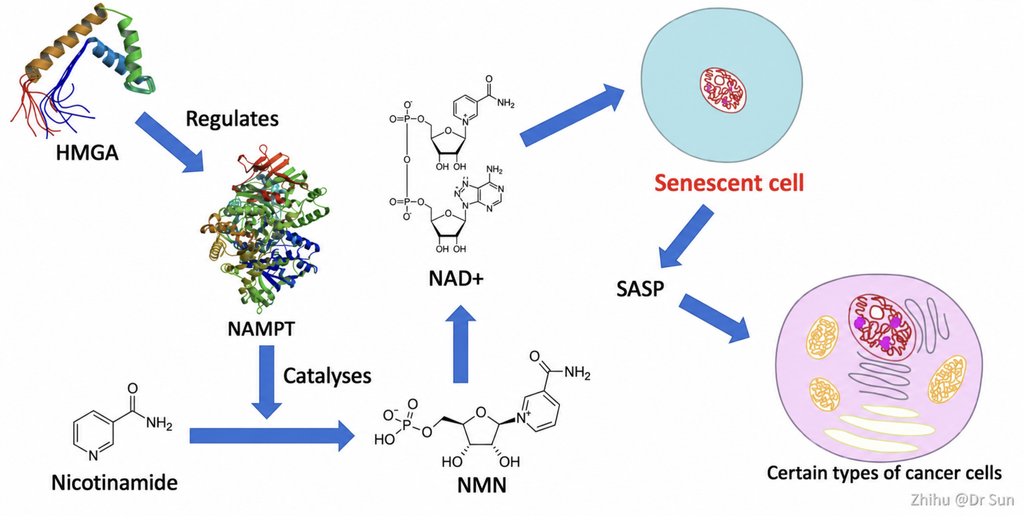
Let us summarise what the authors actually did, which conclusions are sound, and which issues they deliberately avoided. First, they identified a connection between HMGA and NAMPT. They also found that NAMPT activity, through NAD+, can regulate SASP secretion by senescent cells. These are objective findings. There is no problem with them, and they are consistent with other research.
The authors deliberately avoided the fact that all the cancer cell growth observed in their study depended on senescent cells. Instead, they linked NAD+ to cancer cell growth by taking the findings out of context. This is like saying that I cut down a tree with an axe. Although the conclusion is that I cut down the tree, I could not have done it without the axe.
The second issue they avoided is that senescent cells are not the only cause of inflammation. Many other factors can cause it, while NAD+ itself can suppress inflammation through sirtuin enzymes. The study included neither an anti-inflammatory control group nor a control involving the clearance of senescent cells. These are flaws in its experimental design. As early as 2009, a paper in Nature had shown that activating the AMPK pathway can directly increase NAD+ levels. This is also one of the most plausible theories behind the cancer-preventive effects attributed to many plant extracts.
At no point did this study state that NAD+ turns normal cells into cancer cells, or provide evidence that it can do so. All the cancer-related experiments depended on conditions in which cancer cells and senescent cells were already present together. To certain science media outlets without sufficient expertise, I would say this. It is senescent cells that really accelerate cancer progression, rather than NAD+.
The paper was submitted in March 2018 and was not accepted until January 2019. This means that, during those ten months, the reviewers must have required major revisions. Although the paper was ultimately published, its fundamental flaws could not be fixed.
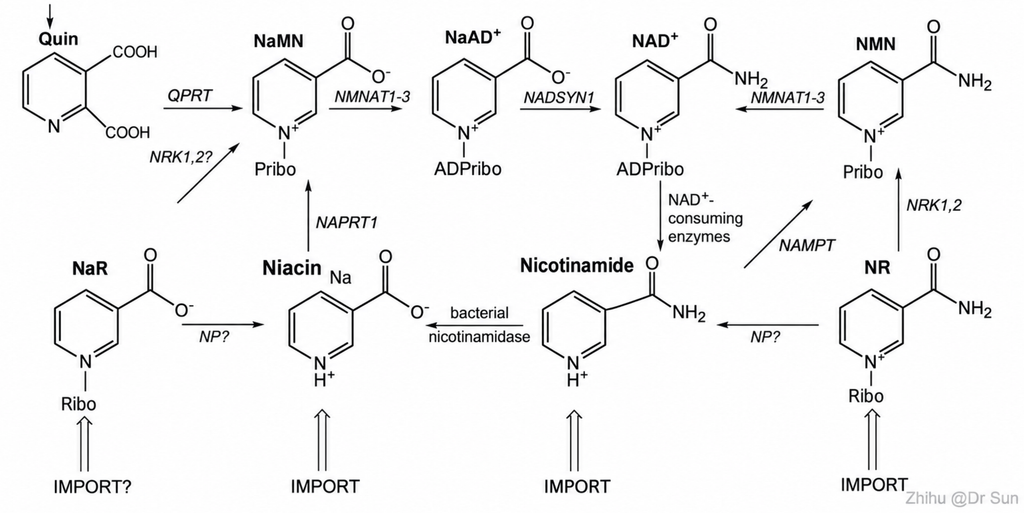
The safety of NAD+ precursors has, in fact, been studied for a long time. Leaving aside the more recently identified precursors NR and NMN, niacin, nicotinamide and tryptophan are three natural ways to replenish NAD+. Among them, niacin is the most direct and effective natural NAD+ precursor. Niacin is a form of vitamin B3 and is found in relatively high amounts in foods such as tuna, turkey, lean pork, sesame seeds and ginger. Its cholesterol-lowering effect was discovered in 1955, making niacin one of the oldest cholesterol-lowering drugs.
Cautious scientists often point out that studies showing lifespan extension with NAD+ precursors are animal studies, and that there is no supporting human clinical evidence. Yet, if we consider the natural NAD+ precursor niacin, there is indirect human clinical evidence. In the last century, a well-known British clinical study called the Coronary Drug Project involved as many as 8,000 people and lasted 16 years, comprising six years of treatment and nine years of follow-up. During the nine-year follow-up, the niacin group was found to have 11% fewer deaths overall than the control group.
At that time, the concept of NAD+ as an anti-ageing intervention had not yet emerged. The authors, and some subsequent commentators, concluded that niacin had a more pronounced effect in patients with high cholesterol. But 44 years later, as the uses and functions of NAD+ have become clearer, the clinical findings can be described this way. Patients who took the NAD+ precursor niacin for six years experienced 11% lower mortality during the following nine years than the control group. The conclusion is therefore straightforward. Taking the NAD+ precursor niacin may reduce mortality. In other words, it extended the lives of that 11% of the population.
It should also be emphasised that thousands upon thousands of people around the world take 3–6 grams of niacin per day to control their cholesterol. From its first use as a cholesterol-lowering drug in 1955 to the time of writing, no cancer-related adverse reactions have been reported. In contrast, a number of cell experiments, animal studies and human epidemiological studies have found that low niacin status may contribute to cancer. More research and commentary on niacin and other NAD+ precursors will be shared in future articles.
References
- Brandauer J, Vienberg SG, Andersen MA, et al. AMP-activated protein kinase regulates nicotinamide phosphoribosyl transferase expression in skeletal muscle. J Physiol. 2013;591(20):5207–20.
- Fulco M, Sartorelli V. Comparing and contrasting the roles of AMPK and SIRT1 in metabolic tissues. Cell Cycle. 2008;7(23):3669–79.
- Canto C, Gerhart-Hines Z, Feige JN, Lagouge M, Noriega L, Milne JC, et al. AMPK regulates energy expenditure by modulating NAD+ metabolism and SIRT1 activity. Nature. 2009;458:1056–1060.
- Costford SR, Bajpeyi S, Pasarica M, Albarado DC, Thomas SC, Xie H, Church TS, Jubrias SA, Conley KE, Smith SR. Skeletal muscle NAMPT is induced by exercise in humans. Am J Physiol Endocrinol Metab. 2010 Jan;298(1):E117–26.
- Fulco M, Cen Y, Zhao P, Hoffman EP, McBurney MW, Sauve AA, et al. Glucose restriction inhibits skeletal myoblast differentiation by activating SIRT1 through AMPK-mediated regulation of Nampt. Dev Cell. 2008;14:661–673.
- “Niacin content per 100 grams; select food subset, abridged list by food groups.” United States Department of Agriculture, Agricultural Research Service, USDA Branded Food Products Database v.3.6.4.1. 17 January 2017. Retrieved 23 January 2017.
- Altschul R, Hoffer A, Stephen JD. Influence of nicotinic acid on serum cholesterol in man. Archives of Biochemistry and Biophysics. 1955 Feb;54(2):558–9. doi:10.1016/0003-9861(55)90070-9.
- Berge KG, Canner PL; Coronary Drug Project Research Group. Coronary drug project: experience with niacin. Eur J Clin Pharmacol. 1991;40 Suppl 1:S49–51.
- Kirkland JB. Niacin and carcinogenesis. Nutr Cancer. 2003;46(2):110–8.
- Kirkland JB. Niacin status and treatment-related leukemogenesis. Mol Cancer Ther. 2009 Apr 1;8(4):725–732. doi:10.1158/1535-7163.MCT-09-0042.